

If you are serving on an HOA board, you quickly learn that there is a lot to keep track of. From budgets and maintenance to homeowner questions and board meetings, there are plenty of decisions that require you to understand your community’s governing documents.
Two of the most important are the HOA bylaws and CC&Rs. While they work together, they serve different purposes.
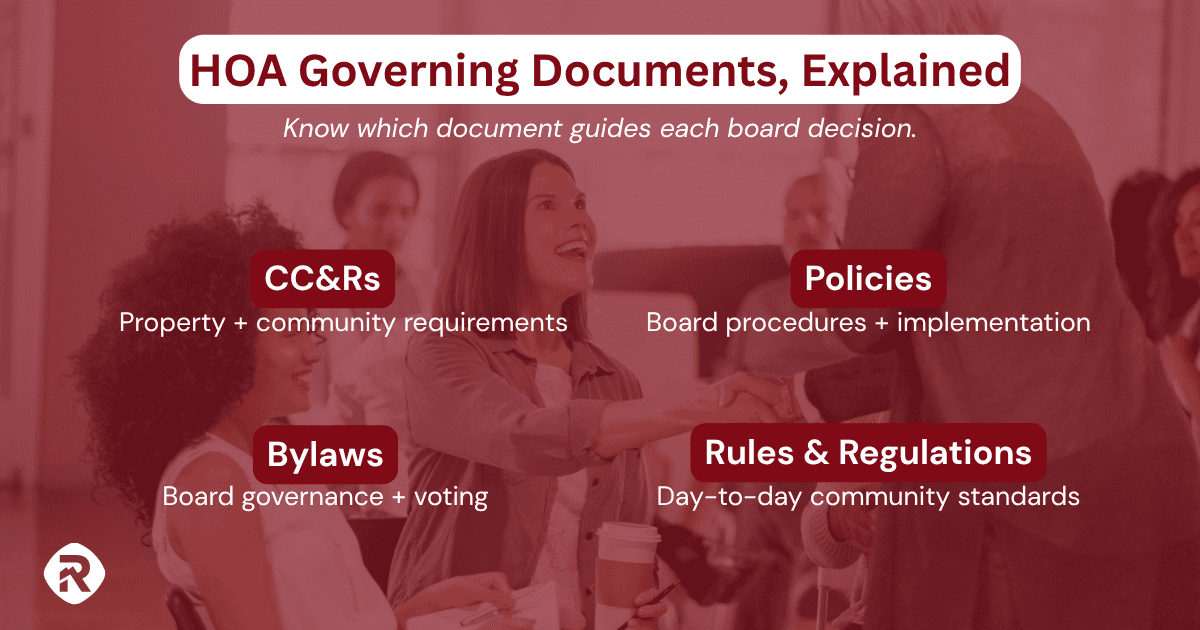
The simplest way to remember the difference is: CC&Rs establish the rules and responsibilities that apply to the community and its properties. Bylaws explain how the HOA itself is governed and operated.
Knowing which document applies to a particular situation can help your board make decisions more confidently and avoid relying on assumptions when questions come up.
CC&Rs stands for Covenants, Conditions, and Restrictions. These documents establish many of the requirements, restrictions, and responsibilities that apply to properties within the community.
CC&Rs commonly address:
For an HOA board, the CC&Rs are an important resource when making decisions about community standards, homeowner responsibilities, assessments, enforcement, and property-related issues.
Because CC&Rs are often recorded against the properties within the community, they can carry significant legal weight. They may also be difficult to amend because changes can affect every property owner in the association.
Your board should always review the specific requirements in your community’s governing documents and applicable law before making decisions about enforcement or amendments.
If the CC&Rs focus largely on the community and its properties, bylaws focus on the association itself.
HOA bylaws establish the basic framework for how the association is governed. They help answer questions about who can serve on the board, how meetings are conducted, and how association decisions are made.
Bylaws commonly address:
For example, if your board is unsure whether it has enough members present to vote on an issue, the bylaws may explain the quorum requirement. If there is a question about how an election should be conducted, the bylaws are another place to start.
In other words, bylaws provide the structure your board uses to run the association.
When a question comes up, start by identifying what type of issue you are dealing with.
If the question involves property restrictions, homeowner obligations, assessments, maintenance responsibilities, or enforcement, review the CC&Rs and any related guidelines or policies.
If the question involves board authority, elections, meetings, voting, quorum, or officer responsibilities, start with the bylaws.
Some situations may involve both. For example, a board may need to review the CC&Rs to determine whether the association has authority to enforce a particular requirement, then review its bylaws or enforcement procedures to determine how the board should act.
The important thing is not to assume that every HOA rule carries the same authority. Take a few minutes to find the provision that actually applies to the situation.
Most communities have more than just bylaws and CC&Rs. Your association may also have rules and regulations, architectural guidelines, policies, resolutions, and other procedures.
These documents help provide the practical details needed to manage the community.
For example, the CC&Rs may give the association authority to establish rules for a community amenity, while a separate policy may establish the specific procedures for using that amenity.
Rules and policies can generally be more flexible than amending the CC&Rs. However, they should not conflict with the association’s governing documents or applicable law.
For a board member, it helps to think of the documents as pieces of the same system. The CC&Rs establish many of the community’s core requirements, the bylaws establish how the association operates, and rules and policies provide additional details for day-to-day management.
This is where things can get complicated.
HOA communities typically operate under multiple governing documents, and the exact relationship between those documents depends on the association’s governing documents and applicable law.
Generally, boards may need to consider:
However, this is not a substitute for reviewing the actual language in your association’s documents. A specific provision may change how an issue should be handled.
If your board finds conflicting language or is unsure whether it has the authority to take a particular action, do not guess. Review the relevant documents and consult the association’s attorney when legal interpretation is needed.
Both bylaws and CC&Rs can potentially be amended, but the process is different from simply changing an everyday community rule.
The governing documents should explain the required amendment process, including whether the board or homeowners must approve the change, what voting threshold applies, and whether an amendment needs to be recorded.
CC&R amendments often require a higher level of homeowner approval because they can affect property rights and obligations throughout the community. Bylaw amendments may have different requirements depending on the association and the provision being changed.
Before your board starts an amendment process, review the existing requirements carefully. Following the correct process helps prevent an otherwise well-intentioned change from creating additional problems later.
You do not need to memorize your entire set of governing documents to be an effective board member. You just need to know where to look and when to ask for help.
A few simple practices can make a difference:
Having a clear process takes some of the pressure off board members, especially when you are volunteering your time and may not have experience with HOA governance.
Being an HOA board member comes with a lot of responsibility. You should have the support and resources to make decisions without feeling like you need to become an expert in HOA law, accounting, maintenance, and everything else that comes with running a community.
Red Rock HOA Management provides personalized management support to help boards navigate the day-to-day responsibilities of managing an HOA. Request a personalized management proposal to learn how Red Rock can support your board and community.
CC&Rs generally establish property-related restrictions, homeowner responsibilities, assessments, and community requirements. HOA bylaws establish how the association is governed, including board elections, meetings, voting, and officer responsibilities.
The board should follow all applicable governing documents and laws. When a specific issue comes up, start with the document that addresses that type of issue and check for related provisions in other documents. If the documents appear to conflict, the board should seek appropriate legal guidance.
Potentially, but the required process depends on the association’s governing documents and applicable law. Amendments may require board approval, homeowner approval, specific voting thresholds, notice, or recording. Boards should review the applicable requirements before making changes.