Thinking about switching HOA management companies? You’re not alone. Whether your community is looking for better communication, stronger financial oversight, more responsive service, or a management partner that’s simply a better fit, changing companies can be a big decision.
The good news? An HOA management transition doesn’t have to be a headache. With the right preparation, documentation, and communication, your board can help make the handoff as smooth as possible.
We’ve put together this HOA management transition checklist to walk your board through the key steps, from reviewing your current contract to transferring financial records, coordinating vendors, and getting your new management company up to speed.
Before making any moves, take a careful look at your existing management contract. Check for termination clauses, required notice periods, renewal dates, and any fees or penalties associated with ending the agreement.
Your HOA board should provide formal written notice according to the terms of the contract. It also doesn’t hurt to send your notice a little earlier than required, when possible, to help avoid pesky auto-renewals or last-minute surprises.
Before selecting a new management company, identify what your community needs most. Are you looking for better communication? Faster responses? More hands-on community management? Stronger financial oversight?
Once you know what matters most, interview potential management companies and ask questions about their services, technology, communication processes, and experience managing communities similar to yours.
It can also be helpful to request a demo of their software and homeowner tools so you know what your board and residents can expect.
One of the biggest pieces of an HOA management transition is making sure your new management company receives the records and information it needs to take over effectively.
Start gathering documents from your current management company as early as possible. As records become available, make sure they are transferred to the new management company.
You can also download our Ultimate HOA Management Transition Checklist to help keep everything organized.
Download The Ultimate HOA Management Transition Checklist PDF
Getting the following information early can help keep the transition moving:
Depending on your community and management agreement, additional records may be needed during the transition.
Once the transition is underway, keep homeowners in the loop.
Send an announcement explaining why the HOA is changing management companies, when the transition will happen, and what homeowners should expect. Be sure to include updated contact information for the new management team and any important changes to payment methods, portals, maintenance requests, or other services.
Clear communication can go a long way toward preventing confusion and unnecessary questions during the transition.
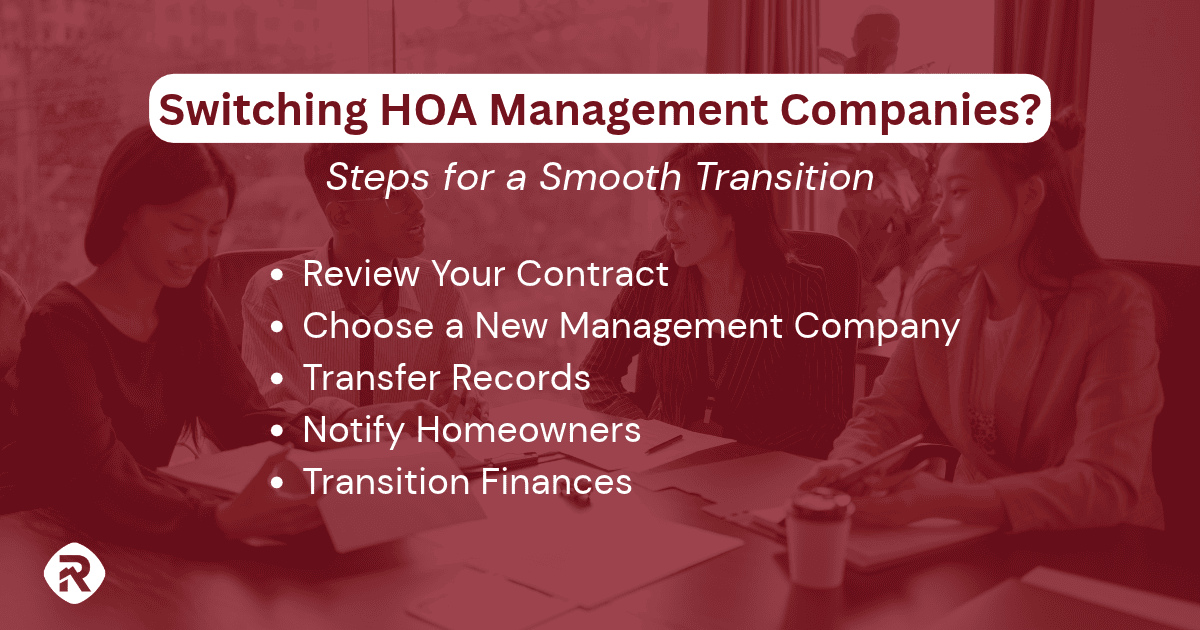
Financial accounts and payment systems should be addressed early in the transition to help prevent disruptions.
Work with your outgoing and new management companies to establish new bank accounts, update authorized signatures, and transition online payment platforms as needed. Your new management company should also receive the homeowner information necessary to establish online access through its management portal.
At Red Rock, we request a closing check issued by the bank to ensure all funds are received and verify that the old account has been closed.
Your vendors need to know about the management change, too.
Make sure contractors and service providers receive updated contact and billing information. Confirm that recurring services, maintenance requests, contracts, and invoices will continue without interruption.
A little coordination here can prevent a lot of “Who should I call?” emails later.
Once your new management company is selected, schedule an onboarding meeting with the HOA board and management team.
Use this meeting to review expectations, responsibilities, community priorities, ongoing projects, upcoming deadlines, and any immediate concerns. It’s a good opportunity to make sure everyone starts on the same page.
Your new management company should get familiar with the community itself, not just its paperwork.
Conduct a property walkthrough to review current conditions, ongoing projects, maintenance needs, amenities, and other areas that may require attention. Documenting these items early gives the new management team a clearer picture of the community from day one.
A successful transition doesn’t end when the paperwork is handed over.
Set regular check-ins with your new management team during the first few weeks or months. Establish clear deadlines for outstanding transition items and determine how the board and management team will communicate moving forward.
Clear expectations from the start can help create a smoother working relationship and keep everyone accountable.
There’s a lot that goes into switching HOA management companies, but the board shouldn’t have to carry the entire workload.
In a typical transition, the outgoing and new management companies coordinate the handoff of records, financial information, homeowner data, vendor information, and other important materials. That said, an informed and proactive HOA board can make a big difference in keeping the transition organized and avoiding a transition trainwreck.
The goal isn’t just to change management companies. It’s to give your community a clean handoff and a strong start with its new management team.
Switching HOA management companies may sound like a lot of moving parts, but the right preparation can make the process much more manageable.
Whether you’re still comparing management companies or already planning your transition, an experienced management team can help keep the process organized from the first notice to the final handoff.
At Red Rock, we’re happy to help make sense of the process, even if you’re just starting to explore your options. Have questions about an upcoming HOA management transition? Get in touch with our team to see how we can help.
The timeline can vary depending on the HOA’s existing contract, notice requirements, community size, records, and complexity of the transition. Boards should start planning as early as possible and review their current management agreement before setting a transition date.
HOAs should generally request important association records such as governing documents, homeowner rosters, financial reports, homeowner account balances, vendor information, contracts, and other records needed to manage the community. The exact records needed will vary by community and management agreement.
The outgoing and new management companies typically coordinate the transfer of records, financial information, homeowner data, vendor information, and other materials. The HOA board still plays an important role by providing direction, reviewing information, communicating with homeowners, and making sure the new management relationship gets off to a strong start.